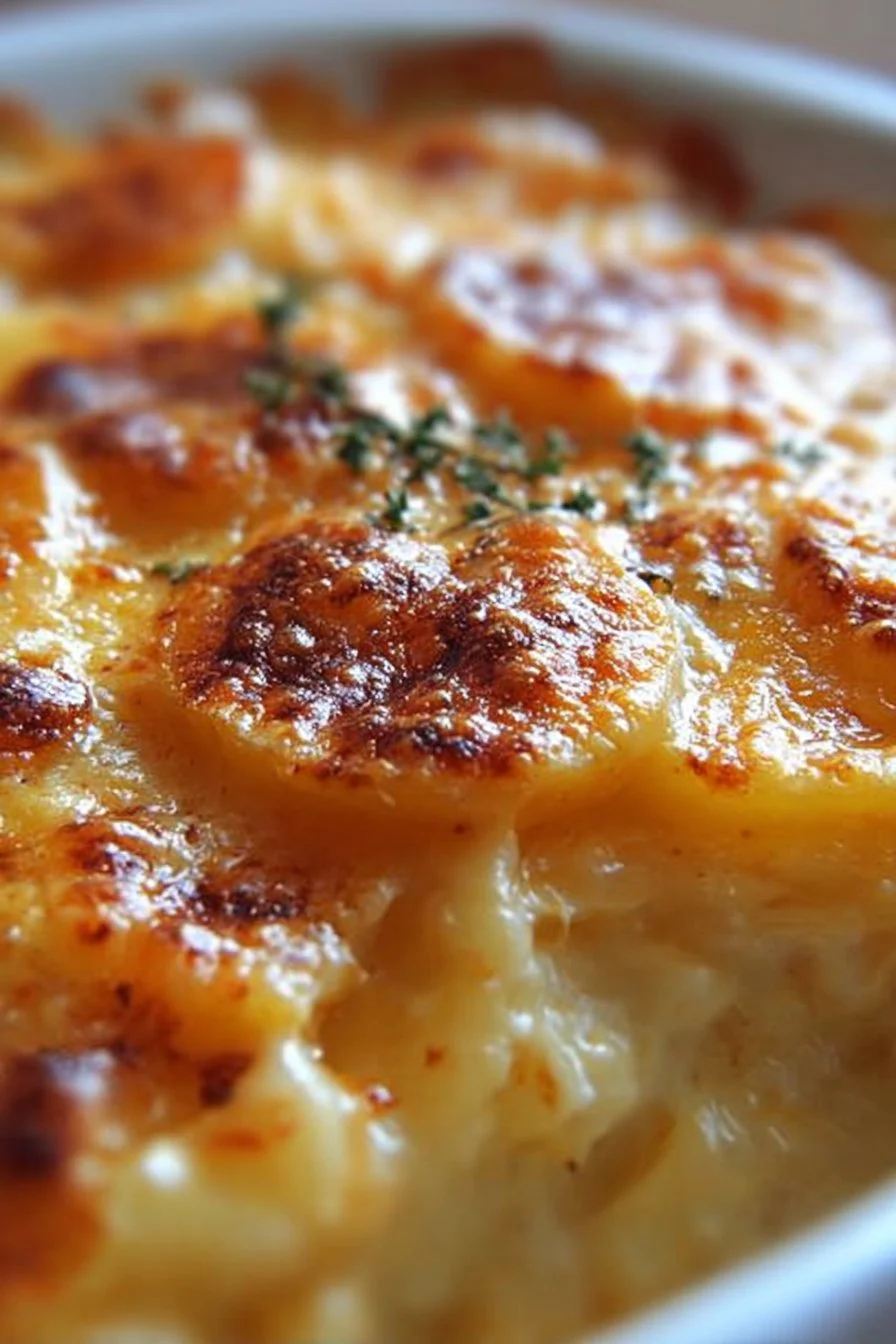
Creamy, cheesy, and impossibly comforting, scalloped potatoes are the kind of side dish that disappears first at family dinners and holidays. Thinly sliced potatoes are layered with a simple cheddar béchamel, baked until bubbling and golden, then rested so each forkful holds together. This version is straightforward enough for weeknights but special enough for a holiday table—switch to a mandoline for uniform slices and you’re halfway to restaurant-worthy texture. If you prefer a sweeter, earthy twist, try a sweet-potato alternative found here: Murasaki sweet potatoes.
Why you’ll love this dish
Scalloped potatoes hit the comfort-food sweet spot: creamy sauce, tender potato, and a crisp, cheesy top. They’re budget-friendly, feed a crowd, and pair well with roasted meats or a simple green salad. Make them for weeknight dinners, potlucks, or holiday spreads—leftovers reheat beautifully.
“Golden on top, silky inside—this is the kind of side that gets requested again and again.” — a neighbor after Sunday dinner
Aside from taste, it’s a forgiving recipe: a reliable roux-based sauce prevents sogginess and holds up well if you make the dish ahead of time.
How this recipe comes together
This recipe follows three main steps:
- Make a cheese sauce by cooking equal parts butter and flour into a roux, then slowly whisking in milk until thickened and glossy. Cheese is stirred in at the end.
- Layer uniformly thin potato slices in a greased 9×13-inch dish, pouring the sauce between layers so everything cooks evenly.
- Bake covered, then uncover to brown the top; rest before serving so slices firm up and cut cleanly.
Expect roughly 15–20 minutes of active prep (longer if you slice by hand) and about 1 hour of combined baking time.
What you’ll need
- 4 cups potatoes, thinly sliced (about 3–4 medium potatoes). Yukon Golds are ideal for creaminess; russets work if you like fluffier texture.
- 3 tbsp unsalted butter (for the roux/cheese sauce)
- 1 1/2 cups milk (whole milk recommended; use half-and-half for an even richer sauce)
- 3 tbsp all-purpose flour (for the roux)
- 1 1/2 cups sharp cheddar cheese, grated (for the sauce)
- 1/2 cup additional grated cheese (cheddar or Gruyère) for the topping
- Salt, to taste
- 1 pinch cayenne pepper (optional, for a subtle heat)
- 1/2 cup sliced green onions, optional garnish
Notes and substitutions:
- For a nuttier, more complex flavor, swap some cheddar for Gruyère.
- For a lighter version, use 2% milk and reduce cheese slightly, though texture will be less luxurious.
- Gluten-free: substitute a 1:1 gluten-free flour blend for the all-purpose flour.
Step-by-step instructions
- Preheat the oven to 375°F (190°C). Grease a 9×13-inch baking dish with butter or non-stick spray.
- Melt 3 tablespoons butter in a medium saucepan over medium heat. Add the 3 tablespoons flour and whisk constantly for 1–2 minutes until the roux turns a pale golden color—this cooks out raw flour taste.
- Slowly pour in 1 1/2 cups milk while whisking to avoid lumps. Bring to a gentle simmer and cook 5–7 minutes, whisking occasionally, until the sauce coats the back of a spoon and is visibly thickened.
- Remove the pan from heat. Stir in 1 1/2 cups grated sharp cheddar until fully melted and smooth. Season with salt to taste and add a pinch of cayenne if using.
- Arrange half of the thin potato slices in a single, slightly overlapping layer in the prepared dish. Pour half the cheese sauce over the potatoes and spread gently to cover. Repeat with the remaining potatoes and the rest of the sauce.
- Sprinkle 1/2 cup extra grated cheese evenly over the top. Cover the dish tightly with foil.
- Bake covered for 45 minutes. Remove foil and bake an additional 15–20 minutes, or until the top is golden and bubbling and a knife slides through potatoes easily.
- Remove from oven and let rest 10–15 minutes before serving to let the sauce set. Garnish with sliced green onions if desired.
Timing tips: if your potatoes are uneven, parboil thicker slices 3–4 minutes to equalize cooking time. Aim for uniform 1/8-inch slices for best texture.
Best ways to enjoy it
Serve scalloped potatoes hot with roast chicken, glazed ham, or a simple pan-seared steak. They’re also excellent alongside roasted Brussels sprouts or a crisp arugula salad to cut the richness. For a gluten-free or vegetarian centerpiece, pair with roasted vegetables and a grain salad.
If you want to explore a sweeter alternative, pairing or substituting with Murasaki sweet potatoes brings a lovely color and flavor contrast—learn more here: Murasaki sweet potatoes.
Presentation tips:
- Spoon into a shallow bowl for family-style service, or slice and plate neatly for holiday guests.
- Finish with a sprinkle of chopped parsley or green onions for color.
Storage and reheating tips
- Refrigeration: Cool to room temperature and refrigerate within 2 hours of baking. Store in an airtight container for 3–4 days.
- Freezing: For longer storage, freeze portions in freezer-safe containers for up to 2 months. Thaw overnight in the fridge before reheating.
- Reheating: Oven method (best for texture): cover with foil and bake at 350°F (175°C) until heated through, about 20–30 minutes for a full dish or 10–15 minutes for portions. Microwave method (fastest): microwave single servings on medium power in 1–2 minute increments until hot.
- Food safety: Because this dish contains dairy, avoid leaving it at room temperature for more than 2 hours to reduce bacterial risk.
Pro chef tips
- Slice evenly: Use a mandoline or a sharp chef’s knife to slice potatoes uniformly (1/8-inch recommended). Even slices cook at the same rate and produce a creamier result.
- Don’t over-sauce: The roux-based cheese sauce should be thick enough to coat a spoon. If it’s too thin the casserole becomes watery; if too thick add a splash of milk.
- Cheese choices matter: Sharp cheddar gives bold flavor; mixing in Gruyère or Parmesan adds nuttiness and depth. Avoid pre-shredded cheese for best melt—those contain anti-caking agents and won’t smooth as well.
- Let it rest: Resting for 10–15 minutes after baking firms the layers and makes cleaner slices.
- Browning trick: For an extra-crispy top, remove the foil in the last 10 minutes and broil on high for 1–2 minutes—watch closely to prevent burning.
Creative twists
- Bacon & caramelized onion: Stir cooked chopped bacon and caramelized onions into the sauce before layering.
- Herb-forward: Add chopped thyme or rosemary to the sauce for an aromatic lift.
- Potato swaps: Use Yukon Golds for creaminess, Russets for a fluffier bite, or sweet potatoes for a sweeter profile.
- Vegetarian/vegan: Replace milk with unsweetened soy or oat milk and use a plant-based shredded cheese and vegan butter; you may need a little extra flour to thicken.
- Topping variations: Swap the extra cheddar for panko mixed with melted butter and Parmesan for a crunchy crust.
Common questions
Q: What’s the difference between scalloped potatoes and potatoes au gratin?
A: The terms are often used interchangeably, but traditionally scalloped potatoes use a creamy sauce between layers, while au gratin usually means potatoes topped with cheese and breadcrumbs and sometimes includes cream. Regional usage varies, so recipes overlap.
Q: Can I make scalloped potatoes ahead of time?
A: Yes. Assemble and refrigerate (covered) for up to 24 hours, then bake as directed (you may need an extra 10–15 minutes if baking straight from the fridge). For full make-ahead, bake, cool, and refrigerate—reheat covered at 350°F until warmed through.
Q: My sauce turned out thin—what went wrong and how do I fix it?
A: Thin sauce can be due to insufficient roux cooking or too much milk. To fix, return the sauce to low heat and whisk in a small slurry of 1 tsp flour mixed with 1 tbsp cold milk at a time until it thickens, or simmer gently to reduce. Thickening also occurs as the casserole rests and bakes.
Q: Which potato is best for scalloped potatoes?
A: Yukon Gold is ideal for a creamy, slightly buttery texture. Russets are fine but can be slightly drier. The key is uniform slicing so all pieces cook evenly.
Q: Can I freeze scalloped potatoes after baking?
A: Yes, freeze in airtight containers for up to 2 months. Thaw overnight in the refrigerator before reheating. Texture can change slightly—reheating in the oven helps restore creaminess.
Q: How do I get a golden, not-burnt top?
A: Bake covered to let everything cook through, then remove the foil to brown. If broiling, watch closely and broil only 1–2 minutes.
If you have a specific dietary need or want wine-pairing suggestions, ask and I’ll tailor tips for your menu.

Scalloped Potatoes
Ingredients
Main Ingredients
- 4 cups potatoes, thinly sliced (about 3–4 medium potatoes) Yukon Golds are ideal for creaminess; russets work for fluffier texture.
- 3 tbsp unsalted butter For the roux/cheese sauce.
- 1.5 cups milk Whole milk recommended; use half-and-half for a richer sauce.
- 3 tbsp all-purpose flour For the roux.
- 1.5 cups sharp cheddar cheese, grated For the sauce.
- 0.5 cups additional grated cheese (cheddar or Gruyère) For the topping.
- Salt To taste.
- 1 pinch cayenne pepper Optional, for a subtle heat.
- 0.5 cups sliced green onions Optional garnish.
Instructions
Preparation
- Preheat the oven to 375°F (190°C). Grease a 9×13-inch baking dish with butter or non-stick spray.
- Melt 3 tablespoons butter in a medium saucepan over medium heat. Add the 3 tablespoons flour and whisk constantly for 1–2 minutes until the roux turns a pale golden color.
- Slowly pour in 1 1/2 cups milk while whisking to avoid lumps. Bring to a gentle simmer and cook for 5–7 minutes until the sauce thickens.
- Remove from heat and stir in 1 1/2 cups grated sharp cheddar until fully melted and smooth. Season with salt and add cayenne if using.
Layering
- Arrange half of the thin potato slices in a single, slightly overlapping layer in the prepared dish.
- Pour half the cheese sauce over the potatoes and spread gently to cover. Repeat with the remaining potatoes and the rest of the sauce.
- Sprinkle 1/2 cup extra grated cheese evenly over the top. Cover the dish tightly with foil.
Baking
- Bake covered for 45 minutes. Remove foil and bake an additional 15–20 minutes, or until the top is golden and a knife slides through potatoes easily.
- Remove from oven and let rest for 10–15 minutes before serving to allow the sauce to set.
- Garnish with sliced green onions if desired.